Engage with Us
We want you to learn more about what we do and why we do it. We invite you to sign up to receive updates to learn how you be part of our work.


Written by Brittaney Baker, Postsecondary Readiness Fellow
MNPS aims to graduate students prepared to take the next step towards a high-wage, high-demand, and high-skill career. One strategy to achieve this goal is through taking advanced coursework while in MNPS, known as Early Post Secondary Opportunities (EPSOs). A NashvillePeer working group of district leaders and university researchers is conducting research to understand trends in EPSO course taking and identify areas for improvement.
Building on this learning, small teams of school personnel, district partners, and Vanderbilt researchers have been working together to improve EPSO course-taking and success at three individual schools. This highly collaborative, relational work, known as co-design, differs from traditional research. It is also not a typical intervention or professional development. In this approach, co-design teams use evidence to develop, test, and scale strategies to improve EPSO course-taking. It is particularly useful when working to address complex issues without a known solution. But what does this work actually look like in practice?
In this post, we delve into the process and implementation of co-design as a form of continuous improvement and discuss the positive impacts this type of learning has cultivated in our first cohort of three partner high schools. This fall, in conjunction with the co-design research that is ongoing in the initial pilot schools, we launched our second cohort of co-design partnerships in three additional high schools to expand networked learning and test scalability.
Since January 2023, NashvillePeer has been facilitating collaboration with researchers, district leaders, and three high schools across the district. The co-design structure brings together school teams to foster shared purpose and enhance student engagement in EPSOs. It also enables cross-school collaboration, integrating support from the district’s Support Hub (including the Office of Research, Assessment, Evaluation and the Department of College and Career Readiness) and Vanderbilt researchers. This approach promotes relationship-building and sustained collaboration across all partners.
School co-design teams are composed of administrators, counselors, teachers, and researchers. These teams work together to: identify barriers and successful methods for engaging more students in EPSO coursework, identify forms of best practice that work in their unique context, and develop a trusted professional network community with student-centered success as its guiding focus.
The core of this work embraces a critical need for communication and collaborative problem solving around a specific problem of practice. For our school-based teams, the problem of practice is centered around increasing student participation, completion, and success in EPSOs.
Each team meeting is guided by a set of norms established at the beginning of the partnership. These norms support an honest and transparent approach to the work, encouraging all participants to share their experiences which, in turn, ensure that they feel valued for their contributions. Meetings follow a consistent pattern, opening with a “warm welcome” (questions serving as a check-in to build community, setting a positive, collaborative tone for the meeting) and closing with structured reflection on what went well and how to improve future meetings. Each meeting also includes discussions around school-specific quantitative and qualitative data, providing time for teams to make sense of data and contribute supplemental narratives to the school and student experience. This process centers the improvement and design work around students’ lived experiences. Throughout each meeting, we facilitate thought-provoking discussion, reflection on key challenges and successes, and goal setting for future implementation.
Example of questions used to prompt discussion for co-design schools during the end-of-year network convening.
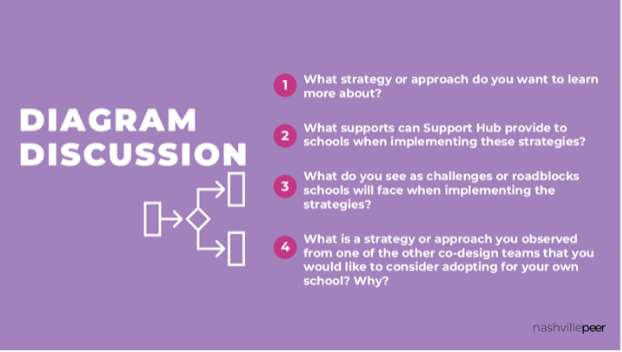
For the 2024 – 2025 academic year, NashvillePeer functioned as a broker, connecting learnings of the co-design teams and MNPS leadership to one another, structured, dedicated time to design and test solutions to improve participation. These efforts illuminated opportunities for alignment between district initiatives and implementation at the school level, with the meetings serving as a healthy environment to engage in rich discussion and problem solving. Meeting with individual partner schools at crucial decision-making points for improving student access to EPSOs (e.g. course offerings, registration, budgeting and student enrollment projections), NashvillePeer provided student data and supported collaborative problem solving to understand how improvement strategies were working.
Engaging in this type of collaborative research enables principals, the school level teams, and district leaders to understand how the implementation of improvement strategies are working, reflect on challenges faced, and share what they are learning with the other schools in the network and in the district. This work led to direct changes in school practice, including:
Early evidence suggests innovations spurred from the co-design research may be making a difference – across all three schools from the first cohort, EPSO enrollment among 11th and 12th graders increased in the subsequent school year. NashvillePeer is continuing to learn more about if and how the changes schools are making through the co-design process are also leading to sustained gains and whether and how these gains translate to improved outcomes for students once they are enrolled in EPSO coursework.
Co-design communication cycle, illustrating NashvillePeer’s work as a broker between MNPS district leaders and school co-design teams

With demonstrated success in our initial cohort of co-design schools, we aim to achieve the following goals in the 2025-26 school year:
Expand the number of co-design schools, increasing the partnership to six schools within the district. The expansion of the network will further develop relationships between the partner schools, facilitate additional paths to best practice for the district, and test scalability for strategies developed during the co-design process
Support co-design teams to further integrate continuous improvement measures, responsive software, and data dashboards. These resources will ensure data is readily available and can meet the needs of schools to discover in real time how policy and change ideas are creating impact for their students. Learning from school teams will allow the district to make data-informed decisions about key initiatives.
Empower student voice. In previous years, the group held focus groups and surveyed students to learn from their insights. Upcoming practice will deepen student engagement by inviting students to attend meetings, workshops, and other collaborative opportunities.
Co-design research has the potential to spark action, build networks, and create shared vision towards a common goal. Its technique is holistic, community-based, and dedicates time and effort for purposeful change. As we’ve seen with our work at NashvillePeer, co-design has the capacity to mobilize change at all levels of the district: from the classroom to school and district leadership, all while keeping the voice of community members at the forefront of its learning.