
Engage with Us
We want you to learn more about what we do and why we do it. We invite you to sign up to receive updates to learn how you be part of our work.
Publication
This blog post was adapted from an interview with Maury Nation and Sarah Suiter of the Youth Success and Wellbeing Working Group.
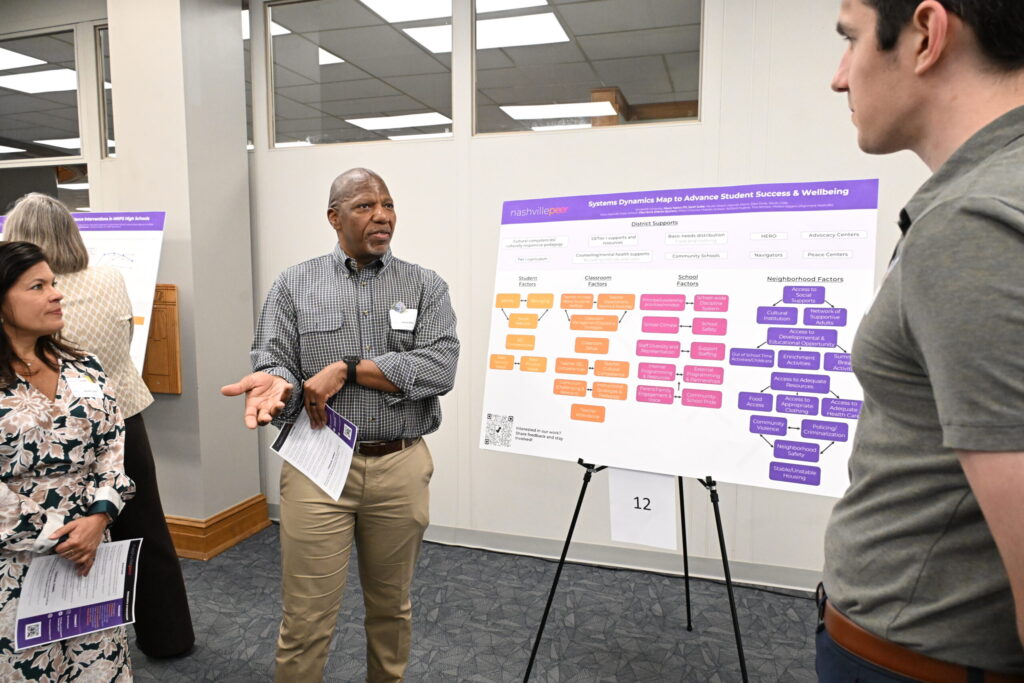
Supporting student success requires understanding more than what happens inside the classroom. Students’ experiences are shaped by a wide range of interconnected influences—including their relationships, learning environments, schools, and neighborhood. Recognizing this complexity, NashvillePeer’s Youth Success and Wellbeing Working Group is developing a systems map to better understand how these factors interact and to inform future decision-making across Metro Nashville Public Schools.
The Youth Success and Wellbeing Working Group brings together MNPS leaders and Vanderbilt University researchers with expertise spanning education, youth development, school and clinical mental health, community development, and violence prevention. Together, the group is examining complex challenges affecting student wellbeing and identifying research-informed strategies that can support students across the district.
The group’s work began with an important question: What are all the factors that shape a student’s experience, and how do they influence one another? Through focus groups with students and families, conversations with educators and community partners, and ongoing collaboration among working group members, the team identified the many conditions that influence students’ experiences and how those conditions connect with one another. The result is an evolving systems map that organizes these conditions into four interconnected areas: student, classroom, school, and neighborhood factors.
Student factors. At the student level, the map highlights factors such as identity, belonging, social networks, social-emotional competencies, and students’ basic physical and security needs. These are experiences students bring with them each day that can influence how they engage in learning and school life.
Classroom factors. The classroom level focuses on the learning environment, including teacher expectations, instructional strategies, culturally responsive teaching, classroom management, curriculum, teacher social-emotional competencies, and classroom setup. Together, these elements illustrate how everyday classroom experiences shape student learning and wellbeing.
School factors. Beyond individual classrooms, the map captures schoolwide conditions such as leadership priorities, school climate, school safety, family engagement, support staffing, internal programming, and community partnerships. These interconnected systems help create the broader environment in which students and educators work.
Neighborhood factors. The map also extends beyond school walls to recognize the role of neighborhoods and communities. Factors such as supportive adult networks, access to educational and enrichment opportunities, food and health care, stable housing, neighborhood safety, and community violence all influence students’ opportunities to thrive. By including these alongside school-based factors, the map reflects the understanding that many influences on student success exist outside schools’ direct control, even as they continue to shape students’ daily experiences.
Importantly, the map does not focus only on challenges. It also highlights the strengths and supports that can promote student wellbeing—from belonging and supportive relationships to community-school pride, enrichment opportunities, and family engagement.
District resources are also represented in the map as supports that connect across multiple parts of the system, including:
The team developed the systems map through an iterative research process grounded in constituent perspectives. The work began with focus groups involving MNPS students and families. Researchers analyzed these conversations to identify recurring themes and relationships, then used those findings to create an initial draft of the map. The Youth Success and Wellbeing Working Group then reviewed and refined the draft, drawing on the expertise of district leaders, researchers, and community partners.
Additional feedback gathered through NashvillePeer meetings and the annual Research Symposium has continued to strengthen the map by identifying missing connections, refining existing relationships, and ensuring it reflects both the challenges students face and the assets that support their success. As with many research tools, the map continues to evolve as new perspectives are incorporated.
The next phase of the work will expand engagement with students, families, educators, district staff, and community partners to further refine and validate the systems map before it is used in more advanced modeling.
The systems map is designed to be more than a visual representation of the education ecosystem. It serves as the foundation for a broader system dynamics model that combines stakeholder perspectives with district and community data.
Building on the relationships identified through qualitative research, the team plans to incorporate MNPS student data to develop simulation models that can explore how different parts of the system interact. Rather than predicting a single outcome, these models will allow district leaders and researchers to examine potential scenarios, better understand how changes in one part of the system may influence others, and identify areas where strategic investments may have the greatest impact.
For MNPS, the map can also support conversations about how district and community resources align around the many factors influencing students’ lives. As the district’s Chief of Student Support Services, Dr. Elisa Norris, explained
“The systems map really is the first step in that conversation: What are the things that we need to consider when we think about all these different factors that impact our students’ lives, and then how do we align our partners to ensure that we’re all rowing in the same direction?”
Like all NashvillePeer work, the systems mapping project is grounded in partnership. The map is not intended to prescribe solutions or suggest that one factor matters more than another. Instead, it creates a shared understanding of a complex system that researchers, district leaders, educators, families, and community partners can continue to refine together.
That continued refinement is an important part of how MNPS and the Working Group see the map being used over time, according to Dr. Norris.
“What we’re most committed to is looking at the map and asking ourselves, ‘Does this still make sense?’ If it does, let’s keep rocking and rolling. If it doesn’t, where do we need to shift some things?”
By making these connections visible, the Youth Success and Wellbeing Working Group is building a resource that can guide future research, support district planning, and strengthen collaboration across schools and community organizations. As the work continues, the systems map will provide a foundation for identifying opportunities to better support the conditions that help every student succeed.
We want you to learn more about what we do and why we do it. We invite you to sign up to receive updates to learn how you be part of our work.